





-1714386257.png)
The main activity of the Company is the establishment and management of Venture Capital Investment Funds within the framework of the provisions of the Capital Markets Board and the relevant legislation.
Media Reflections
Letven Capital's work shaping the venture capital ecosystem, its strategic partnerships and its investment stories can be explored on this page through the coverage they have received in the media.
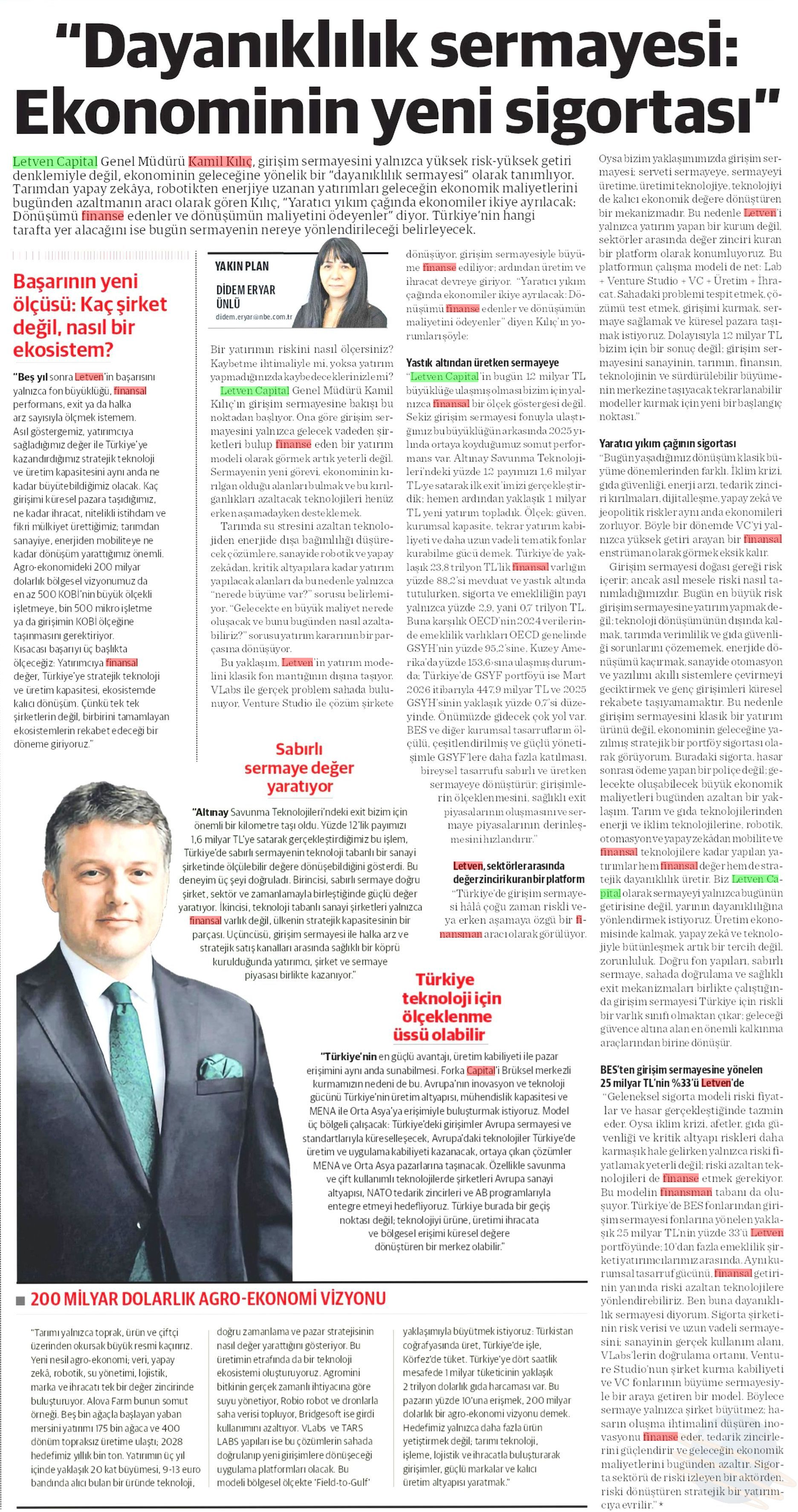
NB Ekonomi: “Resilience capital, the economy’s new insurance policy”
In her “Yakın Plan” column for NB Ekonomi, Didem Eryar Ünlü spoke with Kamil Kılıç, General Manager of Letven Capital, who defines venture capital not as a high-risk, high-return equation but as “resilience capital” written into the future of the economy.
Kılıç sees investments spanning agriculture, artificial intelligence, robotics and energy as a way of reducing tomorrow’s economic costs today. “In the age of creative destruction, economies will divide in two: those that finance transformation, and those that pay its cost,” he says — and which side Türkiye lands on will be decided by where capital is directed now.
A new measure of success: not how many companies, but what kind of ecosystem
“Five years from now, I would not want Letven’s success measured only by fund size, financial performance, or the number of exits and public offerings. Our real indicator will be how far we can simultaneously grow the value we deliver to investors and the strategic technology and production capacity we bring to Türkiye.” Kılıç notes that the USD 200 billion regional vision in agro-economy requires carrying at least 500 SMEs into large-scale enterprises and 1,500 micro businesses or start-ups up to SME scale: “We are entering a period in which it is not individual companies but complementary ecosystems that will compete.”
From money under the mattress to productive capital
“Reaching TRY 12 billion in size today is not, for us, a financial scale indicator,” Kılıç says, pointing to the concrete performance behind eight venture capital funds. In 2025 Letven realised its first exit by selling its 12 percent stake in Altınay Savunma Teknolojileri for TRY 1.6 billion, and raised roughly TRY 1 billion in new investment immediately afterwards. In Türkiye, some 88.2 percent of around TRY 23.8 trillion in financial assets sits in deposits or under the mattress, while insurance and pensions account for just 2.9 percent, or TRY 0.7 trillion. According to OECD data for 2024, pension assets reach 95.2 percent of GDP across the OECD and 153.6 percent in North America, whereas Türkiye’s venture capital fund portfolio stood at TRY 447.9 billion as of March 2026 — roughly 0.7 percent of 2025 GDP.
A platform that builds value chains across sectors
“In Türkiye, venture capital is still too often seen as a financing instrument peculiar to risky or early-stage ventures. In our approach, venture capital is a mechanism that turns wealth into capital, capital into production, production into technology, and technology into lasting economic value.” On that basis, Kılıç says, Letven is positioned not simply as an investor but as a platform that builds value chains across sectors. The operating model is explicit: Lab + Venture Studio + VC + Production + Export. “TRY 12 billion is not an end point for us; it is a new starting point for building repeatable models that place venture capital at the centre of industry, agriculture, finance, technology and sustainable growth.”
Patient capital creates value
The Altınay exit confirmed three things, according to Kılıç: patient capital creates strong value when combined with the right company, sector and timing; technology-based industrial companies are not merely financial assets but part of the country’s strategic capacity; and when a healthy bridge is built between venture capital and the public offering and strategic sale channels, investors, companies and the capital market all win together.
Türkiye can be a scaling base for technology
“Türkiye’s strongest advantage is that it can offer manufacturing capability and market access at the same time. That is precisely why we established Forka Capital with its headquarters in Brussels.” The model will operate across three regions: ventures in Türkiye will globalise with European capital and standards, European technologies will gain production and application capability in Türkiye, and the resulting solutions will be carried into MENA and Central Asian markets. In defence and dual-use technologies in particular, the aim is to integrate companies with European industrial infrastructure, NATO supply chains and EU programmes. “Türkiye is not a transit point here; it can be a hub that turns technology into products, production into exports and regional access into global value.”
Insurance for the age of creative destruction
At a moment when the climate crisis, food security, energy supply, supply-chain disruption, digitalisation, artificial intelligence and geopolitical risk are pressing on economies all at once, Kılıç argues it is inadequate to see venture capital only as a financial instrument chasing high returns. “The biggest risk today is not investing in venture capital; it is being left outside the technology transformation, failing to solve productivity and food security problems in agriculture, missing the energy transition, delaying the conversion of automation and software into intelligent industrial systems, and being unable to carry young ventures into global competition.” He therefore describes venture capital not as a conventional investment product but as strategic portfolio insurance written on the future of the economy: “The insurance here is not a policy that pays out after the damage; it is an approach that reduces tomorrow’s large economic costs starting today.”
A third of the TRY 25 billion flowing from pension funds into venture capital sits with Letven
The traditional insurance model prices risk and indemnifies once damage occurs. But as climate risk, disasters, food security and critical infrastructure risks grow more complex, Kılıç argues, pricing risk is no longer enough — the technologies that reduce it must also be financed. The funding base for that model is already forming: of the roughly TRY 25 billion flowing from Türkiye’s private pension funds into venture capital funds, 33 percent sits in Letven’s portfolio, with more than ten pension companies among its investors. “It is a model that brings together an insurer’s risk data and long-term capital with industry’s real use case, the validation environment of VLabs, Venture Studio’s company-building capability and the growth capital of VC funds. Capital then does more than grow companies; it finances the innovation that lowers the probability of damage, strengthens supply chains and reduces tomorrow’s economic costs today. The insurance sector, in turn, evolves from an actor that monitors risk into a strategic investor that transforms it.”
A USD 200 billion agro-economy vision
The new generation of agro-economy brings data, artificial intelligence, robotics, water management, logistics, branding and exports together in a single value chain, and Kılıç points to Alova Farm as the concrete example: a blueberry investment that began with 5,000 trees has reached 175,000 trees and production across 400 decares, with a target of 1,000 tonnes a year by 2028. A technology ecosystem is being built around that production — Agromini manages irrigation according to the plant’s real-time needs, Robio gathers field data through robots and drones, Bridgesoft tracks input use, while VLabs and TARS LABS will serve as application platforms where these solutions are validated in the field and turned into new ventures. The model is being scaled regionally under a “Field-to-Gulf” approach: produce across the Turkic geography, process in Türkiye, consume in the Gulf. “Within four hours of Türkiye there are one billion consumers with roughly USD 2 trillion in food spending. Reaching 10 percent of that market means a USD 200 billion agro-economy vision.”